Humanoid Robots: How AI-Powered Humanoid Robots Are Entering the Workforce in 2026
- Internet Pros Team
- March 29, 2026
- AI & Technology
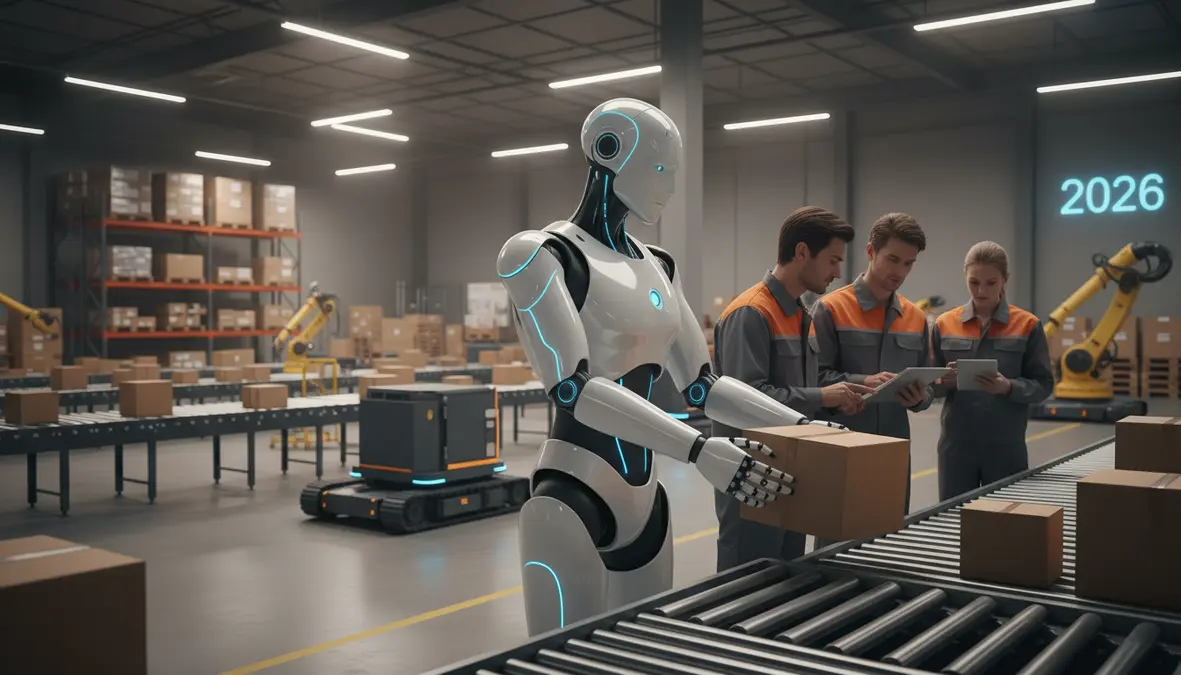
In January 2026, a BMW assembly plant outside Munich became the first automotive factory in history to deploy humanoid robots on a production line alongside human workers. Thirty-two Figure 02 robots — each standing five feet six inches tall and weighing 130 pounds — now perform door panel installation, quality inspection, and parts transport across three shifts, seven days a week. They do not stumble. They do not drop components. They learn new tasks in under two hours by watching a single human demonstration. Across the Pacific, Tesla's Fremont gigafactory runs 200 Optimus Gen 3 units that sort batteries, carry 40-pound trays, and navigate dynamic factory floors with zero safety incidents since deployment. The age of humanoid robots in the workforce is no longer a distant promise — it is an operational reality reshaping manufacturing, logistics, healthcare, and beyond.
Why Humanoid Robots, Why Now?
Robotics has been transforming industry for decades, but traditional industrial robots are fixed-arm machines bolted to factory floors, designed to repeat a single motion millions of times. They cannot walk to a new station, climb stairs, open doors, or adapt to environments built for humans. The human world — its doorways, staircases, tools, switches, and workstations — was designed around the human body. A robot that shares the human form factor can operate in these environments without costly infrastructure retrofits.
Three converging breakthroughs have made general-purpose humanoid robots viable in 2026. First, foundation models for robotics — large neural networks pre-trained on millions of hours of video, simulation data, and language instructions — give robots common-sense understanding of physical tasks. Second, sim-to-real reinforcement learning allows robots to practice millions of task variations in photorealistic simulation before deploying in the real world, dramatically compressing training timelines. Third, advances in actuators, sensors, and battery technology have delivered the torque density, proprioception, and runtime needed for full-day operation in industrial settings.
| Company | Robot | Height / Weight | Key Capability | Status (2026) |
|---|---|---|---|---|
| Tesla | Optimus Gen 3 | 5'8\" / 125 lb | Battery sorting, tray carrying, factory navigation | 200+ deployed in Tesla factories |
| Figure AI | Figure 02 | 5'6\" / 130 lb | Dexterous assembly, multi-step task learning | Commercial deployments at BMW, Amazon |
| Boston Dynamics | Atlas (Electric) | 5'0\" / 190 lb | Whole-body dynamic movement, heavy payload | Pilot programs at Hyundai facilities |
| Agility Robotics | Digit 3 | 5'9\" / 140 lb | Warehouse tote manipulation, stair traversal | Fleet deployment at Amazon, GXO Logistics |
| 1X Technologies | NEO Beta | 5'7\" / 66 lb | Home assistance, gentle human-safe interaction | Closed beta with residential partners |
| Apptronik | Apollo 2 | 5'8\" / 160 lb | Logistics palletizing, retail stocking | Pilots at Mercedes-Benz, GXO |
The AI Brain Behind the Body
What separates 2026 humanoid robots from earlier prototypes is not their hardware — it is their intelligence. Modern humanoid robots run on vision-language-action (VLA) models that unify perception, language understanding, and motor control into a single neural network. Google DeepMind's RT-X and Robotic Transformer 3 (RT-3) models, trained on data from dozens of robot embodiments, enable a robot to understand a spoken instruction like "pick up the red box and place it on the second shelf" and translate that into a fluid sequence of arm movements, grasps, and navigation actions — even if it has never seen that specific shelf configuration before.
Foundation Models for Robotics
Large pre-trained models like RT-3, OpenAI's robotics model, and NVIDIA GR00T give robots generalized physical reasoning. They understand object permanence, weight estimation, material properties, and spatial relationships without explicit programming for each scenario.
Sim-to-Real Transfer
Robots train in NVIDIA Isaac Sim and other photorealistic simulators for thousands of hours, mastering tasks like opening cabinets, folding towels, and navigating cluttered spaces — then transfer those skills to physical hardware with minimal fine-tuning.
Learning from Demonstration
Imitation learning allows humanoids to acquire new tasks by watching a human perform them once or twice. Figure 02 learned to make coffee by observing a 10-minute barista demonstration — no code, no reward function, just visual imitation refined through practice.
Where Humanoid Robots Are Working Today
The first commercial deployments in 2026 concentrate on structured environments with high labor costs and repetitive physical tasks — but they are expanding rapidly.
Warehousing and Logistics: Amazon's fulfillment centers now use fleets of Digit 3 robots to move totes between shelving units and packing stations. Unlike fixed conveyor systems, humanoid robots navigate the same aisles as human workers, pick items from standard shelving, and adapt when layouts change. GXO Logistics reports a 34% throughput increase at facilities using humanoid-human hybrid teams, with robots handling the physically demanding tote-carrying while humans focus on complex picking and exception handling.
Automotive Manufacturing: BMW's Munich deployment is the most visible, but Toyota, Hyundai, and Mercedes-Benz all have active pilot programs. Humanoids excel at tasks too variable for traditional automation but too ergonomically punishing for humans — installing wiring harnesses inside vehicle cabins, attaching under-body components while crouching, and performing repetitive quality inspections that require craning into awkward positions for eight-hour shifts.
Healthcare and Elder Care: Japan's SoftBank and Toyota Research Institute have deployed humanoid assistants in 40 elder-care facilities. These robots help residents stand from chairs, carry meal trays, fetch medications, and provide companionship. In a nation where 30% of the population is over 65 and the caregiver shortage exceeds 690,000 workers, humanoid robots are not replacing human caregivers — they are making it possible for overstretched staff to provide adequate care.
"The humanoid form factor is not a vanity project — it is an engineering necessity. The built environment is designed for human bodies. A robot that can use the same tools, navigate the same spaces, and manipulate the same objects as a human can be deployed anywhere humans work, without redesigning the facility. That is the entire point."
The Economics of Humanoid Labor
The financial case for humanoid robots is becoming compelling. Figure AI prices the Figure 02 at approximately $50,000 per unit at scale — roughly equivalent to one year's fully loaded cost of a warehouse worker in the United States. But the robot operates 20 hours per day (with 4 hours for charging), does not require healthcare benefits, workers' compensation, or shift scheduling, and has an expected operational lifespan of 5–7 years. Goldman Sachs estimates the total addressable market for humanoid robots at $38 billion by 2030 and $152 billion by 2035, potentially displacing the need for 4% of U.S. manufacturing labor and 2% of global logistics labor within a decade.
However, the economics are not purely substitutional. Many industries face structural labor shortages — manufacturing has 600,000 unfilled positions in the U.S. alone, and logistics companies struggle with 300% annual turnover for physically demanding roles. Humanoid robots fill positions that companies literally cannot staff, rather than displacing willing workers.
| Cost Factor | Human Worker (Annual) | Humanoid Robot (Annual, Amortized) |
|---|---|---|
| Base compensation / purchase | $42,000–$55,000 | $8,000–$12,000 (amortized over 5 years) |
| Benefits and insurance | $12,000–$18,000 | $2,000 (maintenance contract) |
| Operating hours per day | 8 hours | 20 hours |
| Downtime and turnover costs | $5,000–$15,000 | Minimal (predictive maintenance) |
| Training for new tasks | Weeks to months | Hours (demonstration learning) |
Safety, Regulation, and the Path Forward
Deploying 130-pound machines alongside human workers demands rigorous safety engineering. Every commercial humanoid robot in 2026 includes force-limited actuators that cap exerted force at levels safe for human contact, 360-degree LIDAR and depth cameras for human proximity detection, and emergency stop systems that trigger within 50 milliseconds. ISO 10218 and ISO/TS 15066 — the international standards for collaborative robots — are being updated to address humanoid-specific scenarios, including bipedal locomotion hazards, full-body collision geometry, and autonomous navigation in shared spaces.
Regulatory frameworks are evolving rapidly. The EU's AI Act classifies humanoid robots operating in workplaces as "high-risk AI systems," requiring conformity assessments, human oversight mechanisms, and transparent documentation of capabilities and limitations. OSHA in the United States has issued preliminary guidance for humanoid robot integration, focusing on workspace design, emergency procedures, and human-robot interaction zones. China's Ministry of Industry and Information Technology released a national humanoid robot development roadmap in late 2025, targeting mass production capability and standardized safety certification by 2027.
The trajectory is clear: humanoid robots are not replacing humanity's workforce — they are augmenting it, filling the positions no one wants and performing the tasks that break human bodies. By 2030, Goldman Sachs, McKinsey, and the International Federation of Robotics project between 1 and 2 million humanoid robots will be operating globally across manufacturing, logistics, healthcare, construction, and agriculture. The companies investing in humanoid integration today — developing hybrid workflows, retraining workers for supervisory roles, and building the infrastructure for human-robot collaboration — will define the next era of industrial productivity. The humanoid revolution is not approaching. It is clocking in for its first shift.