Nuclear Fusion Energy: The Race to Commercial Fusion Power Is Finally Getting Real in 2026
- Internet Pros Team
- April 3, 2026
- AI & Technology
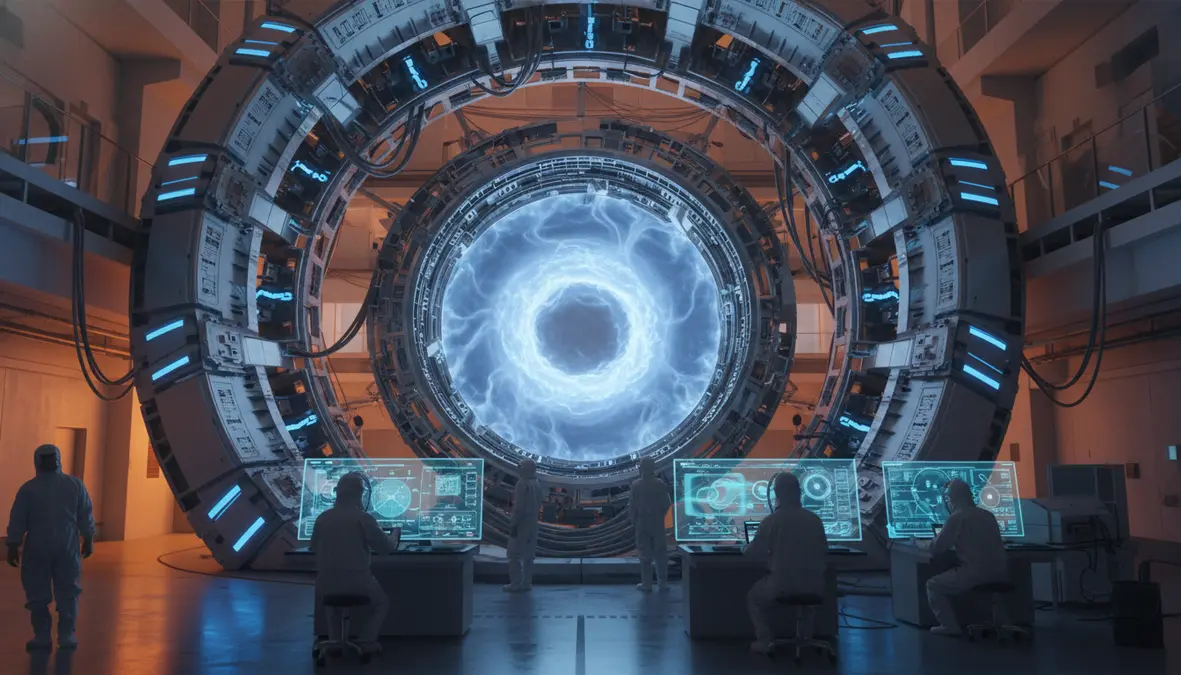
On December 5, 2025, Commonwealth Fusion Systems fired up SPARC — the world's first compact tokamak built with high-temperature superconducting (HTS) magnets — and achieved a plasma temperature of 150 million degrees Celsius, ten times hotter than the core of the sun. For the first time in a privately funded reactor, the device produced more energy from fusion reactions than the energy required to heat and confine the plasma. The age of fusion "never" being practical quietly ended. In 2026, the question is no longer if fusion will work, but which company will deliver commercial power first — and the race has never been more competitive, better funded, or closer to the finish line.
How Nuclear Fusion Works
Nuclear fusion is the process that powers the sun and every star in the universe. It works by forcing light atomic nuclei — typically isotopes of hydrogen called deuterium (abundant in seawater) and tritium (bred from lithium) — to collide at extreme temperatures and pressures until they fuse into helium, releasing enormous amounts of energy in the process. A single gram of fusion fuel releases roughly the same energy as burning eight tons of coal, with no carbon emissions, no long-lived radioactive waste, and no risk of meltdown.
The challenge has always been confinement. At 150 million degrees, fusion plasma is far too hot for any physical material to contain. For seven decades, physicists have pursued two primary approaches: magnetic confinement, which uses powerful magnetic fields to suspend the plasma in a donut-shaped chamber called a tokamak (or a twisted variant called a stellarator), and inertial confinement, which uses ultra-powerful lasers to compress tiny fuel pellets to fusion conditions in billionths of a second. Both approaches have now demonstrated scientific proof-of-concept — the remaining challenge is engineering them into reliable, cost-effective power plants.
The Fusion Landscape in 2026
The fusion industry has undergone a radical transformation. What was once an exclusively government-funded, multi-decade research endeavor is now a $7.1 billion private sector race involving over 40 companies across 12 countries. Venture capital firms, sovereign wealth funds, and tech billionaires have poured money into fusion startups at unprecedented rates, drawn by the promise of a $40 trillion addressable energy market and the existential urgency of climate change.
| Company / Project | Approach | Key Milestone (2025–2026) | Target for Grid Power |
|---|---|---|---|
| Commonwealth Fusion Systems | Compact tokamak with HTS magnets | SPARC achieves net energy gain (Q > 1) | ARC commercial plant by 2030 |
| Helion Energy | Field-reversed configuration (FRC) | Polaris prototype reaches fusion temperatures, Microsoft PPA signed | 2028 (direct electricity conversion) |
| TAE Technologies | Beam-driven field-reversed configuration | Copernicus reactor sustains stable plasma above 75 million °C | 2030 (hydrogen-boron fuel cycle) |
| ITER | Large-scale tokamak (international) | First plasma scheduled for late 2026 after construction delays | 2035 (Q = 10 demonstration) |
| Tokamak Energy | Spherical tokamak with HTS magnets | ST80-HTS achieves 100 million °C plasma in compact form factor | 2030 |
| Zap Energy | Sheared-flow Z-pinch (no magnets) | FuZE-Q device demonstrates neutron production at fusion-relevant densities | 2030 |
The Superconducting Magnet Revolution
The single most important technological breakthrough enabling this new era of fusion is the high-temperature superconducting (HTS) magnet. Traditional fusion reactors like ITER use low-temperature superconductors — niobium-tin alloys that must be cooled to -269°C with liquid helium. These magnets work, but they are enormous, expensive, and slow to ramp. HTS magnets, made from a material called REBCO (rare-earth barium copper oxide), superconduct at much higher temperatures (-196°C, achievable with liquid nitrogen) and produce magnetic fields twice as strong in a fraction of the volume.
In September 2021, Commonwealth Fusion Systems demonstrated a 20-tesla HTS magnet — the most powerful fusion-class magnet ever built. That single achievement changed the economics of fusion overnight. Stronger magnets mean the plasma can be confined in a smaller chamber. A smaller chamber means less material, faster construction, and dramatically lower costs. SPARC is roughly 1/40th the volume of ITER but aims to match its performance. This is the "iPhone moment" for fusion: the technology that makes reactors small and affordable enough to mass-produce.
Magnetic Confinement
Tokamaks and stellarators use magnetic fields to suspend plasma in a toroidal (donut) shape. The leading approach for sustained, steady-state fusion power. CFS, ITER, and Tokamak Energy all use this method with varying magnet technologies and chamber geometries.
Inertial Confinement
The National Ignition Facility (NIF) at Lawrence Livermore uses 192 ultra-powerful lasers to compress a BB-sized fuel pellet to fusion conditions. NIF achieved ignition in December 2022, proving the physics. Commercial inertial fusion companies like Focused Energy are now engineering repetition rates.
Alternative Approaches
Companies like Helion, TAE, and Zap Energy use novel confinement methods — field-reversed configurations, Z-pinch, and magnetized target fusion — that promise simpler, cheaper reactors. These dark horse approaches have attracted billions in funding and are advancing rapidly.
AI and Machine Learning in Plasma Control
One of the most underappreciated drivers of fusion progress is artificial intelligence. Controlling a 150-million-degree plasma is one of the most complex real-time control problems in physics. The plasma is inherently unstable — subject to dozens of instability modes (kinks, tearing modes, edge-localized modes) that can disrupt confinement in milliseconds. Traditional PID controllers struggle with this chaos. AI doesn't.
In 2024, DeepMind demonstrated a deep reinforcement learning system that could control plasma shape and position in the TCV tokamak in Switzerland with superhuman precision. By 2026, every major fusion company uses AI-driven plasma control. Commonwealth Fusion Systems trains neural networks in digital twin simulations of SPARC, then deploys them to control the real reactor's magnetic coils in real time — adjusting thousands of parameters per second to maintain optimal confinement. TAE Technologies uses machine learning to optimize beam injection timing, while Helion uses AI to predict and preemptively correct plasma instabilities before they develop.
"Fusion is no longer a physics problem — it's an engineering and manufacturing problem. The physics is solved. What remains is building the machines reliably and affordably, and that's exactly what the private sector excels at."
The Economics of Fusion Power
Skeptics have long argued that even if fusion works, it will be too expensive to compete with increasingly cheap solar and wind. But the economics are more nuanced. Solar and wind are intermittent — they require massive battery storage or gas backup to provide reliable baseload power. Fusion provides 24/7 baseload power with zero carbon emissions, in a footprint far smaller than solar or wind farms. A single fusion plant the size of a city block could power 200,000 homes indefinitely.
The fuel is essentially unlimited. Deuterium is extracted from seawater — there's enough to power civilization for billions of years. Tritium is bred inside the reactor from lithium, which is abundant. The waste product is helium, an inert noble gas with its own commercial value. And unlike fission reactors, a fusion reactor cannot melt down — if confinement is lost, the plasma cools instantly and the reaction stops. There is no chain reaction to contain, no Chernobyl scenario, and no long-lived nuclear waste requiring geological storage.
- Fuel cost: Near zero. Deuterium from seawater costs ~$13 per gram; one gram powers a household for a year
- Carbon emissions: Zero during operation. Minimal lifecycle emissions from construction
- Waste: Helium (non-radioactive) plus low-level activated structural materials with ~100-year half-lives
- Safety: Inherently safe. No meltdown risk, no chain reaction, plasma self-extinguishes if containment fails
- Land use: ~1/500th the land area of equivalent solar capacity
- Reliability: Baseload capable — operates 24/7 regardless of weather or time of day
What Comes Next: The Path to 2030
The fusion industry's immediate roadmap is clear. Commonwealth Fusion Systems is building ARC — its first commercial-scale fusion power plant — in Devens, Massachusetts, with a target of generating electricity for the grid by 2030. Helion has already signed the world's first fusion power purchase agreement with Microsoft, committing to deliver 50 megawatts of fusion electricity by 2028. The U.S. Department of Energy's Bold Decadal Vision for Commercial Fusion has committed $1.4 billion in public funding to accelerate private fusion companies. The UK's STEP program is building a prototype fusion plant in Nottinghamshire. China's EAST tokamak continues to set records for sustained plasma operation.
Regulatory frameworks are also falling into place. In 2023, the U.S. Nuclear Regulatory Commission ruled that fusion plants will be regulated under a streamlined framework separate from fission reactors — a decision that removes one of the biggest bureaucratic barriers to commercial deployment. The EU and UK have followed with similar regulatory clarity.
The challenges ahead are real but tractable. Tritium supply is currently limited — the world's inventory is measured in kilograms, not tons — so reactors must demonstrate tritium breeding (producing more tritium than they consume) as a closed fuel cycle. Materials that can withstand decades of neutron bombardment at fusion energy levels must be qualified. And the manufacturing supply chain for HTS magnets, vacuum vessels, and precision plasma-facing components must scale from prototype to production volumes.
But for the first time in fusion's 70-year history, these are engineering problems with known solutions and funded timelines — not open physics questions. The private sector has brought urgency, accountability, and manufacturing discipline to a field that was once defined by perpetual delays. The joke that fusion is "always 30 years away" has finally expired. In 2026, fusion is 4–8 years away — and the companies building it are on the clock.