Perovskite Tandem Solar Cells in 2026: How Oxford PV, Qcells, LONGi, Trinasolar, and First Solar Are Pushing Past 30% Efficiency to Reshape Utility-Scale and Rooftop Solar
- Internet Pros Team
- June 6, 2026
- AI & Technology
For seventy years, silicon photovoltaics have been the only chemistry the solar industry took seriously at scale. In 2026, that monoculture is ending. Oxford PV in Brandenburg, Hanwha Qcells at its Cartersville Georgia and Daejeon Korea lines, LONGi Solar, Trinasolar, JinkoSolar, JA Solar, First Solar, and Chinese pure-play Microquanta Semiconductor are shipping the first commercial-scale perovskite-on-silicon tandem solar modules — devices that stack a 1.68 eV wide-bandgap perovskite on top of a tuned silicon bottom cell and convert sunlight at 26-28% module efficiency, a level no single-junction silicon panel can ever reach. Cell-level records have already crossed 33.9% at LONGi and the Helmholtz-Zentrum Berlin / KAUST / Fraunhofer ISE groups. The Shockley-Queisser ceiling that capped silicon at 29.4% has, for utility-scale customers, finally been broken.
Why a Tandem Beats a Single Silicon Cell
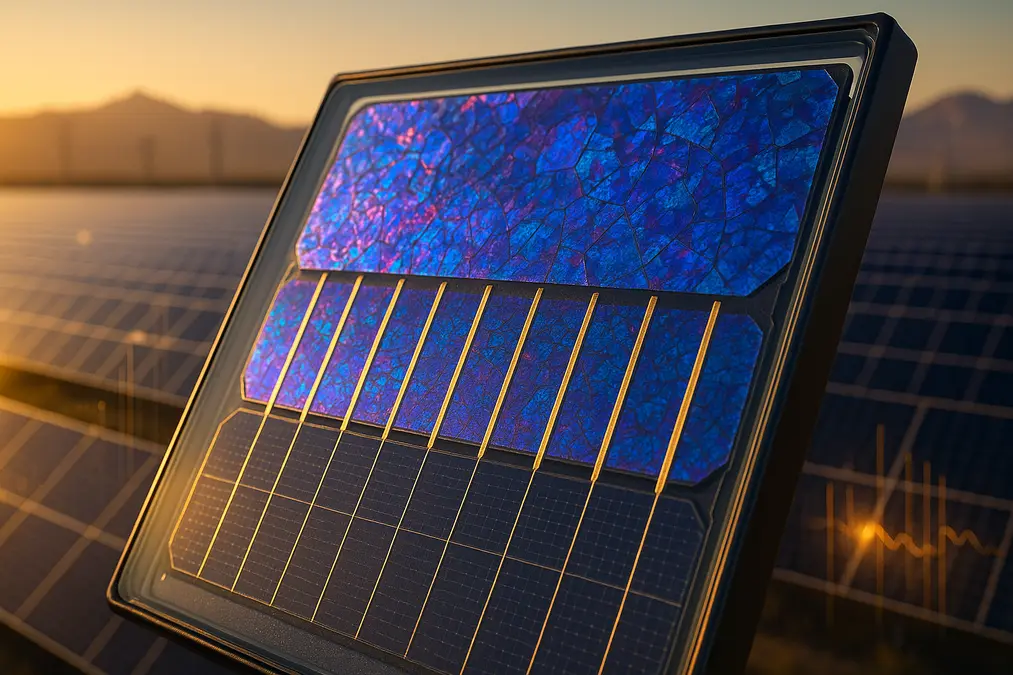
A silicon solar cell turns roughly 22-25% of incident sunlight into electricity in production, and is bounded by physics around 29.4% at the cell level — a hard ceiling set by the trade-off between absorbing low-energy red photons and not wasting voltage on high-energy blue ones. A tandem cell sidesteps that limit by stacking two materials with different bandgaps. The top layer — a perovskite tuned to ~1.68 eV — absorbs the blue and green photons at high voltage. The bottom layer — a TOPCon, HJT, or interdigitated back contact silicon cell at 1.12 eV — mops up the red and infrared light that slips through. With proper current matching at a recombination tunnel junction, the two cells in series produce dramatically more energy from the same square meter of glass.
For an 800-watt utility module that already exists today as TOPCon or HJT silicon, that 5-7 absolute percentage points of efficiency uplift translates into ~25-30% more annual energy yield per acre of land, per truck shipped, per inverter wired, and per BOS dollar spent. For solar developers competing on levelized cost of electricity (LCOE), it is the single largest jump the technology has seen since the move from polycrystalline to PERC silicon a decade ago.
"The thing nobody understood five years ago is that tandem is not a different product — it is the same module form factor, same racking, same inverter, same warranty conversation, with a 25-30% bigger number on the back of the panel. That is why utilities and rooftop installers are leaning in now and not waiting for the perfect chemistry."
Who Is Actually Shipping Tandem Modules in 2026
| Company | Approach | 2026 Status |
|---|---|---|
| Oxford PV (UK / Germany) | Spin-out of Oxford University and the Henry Snaith group. Perovskite-on-silicon tandem produced at the Brandenburg an der Havel pilot fab in Germany; cell records up to 28.6% on full-area M6 wafers and commercial modules in the 24-26% efficiency class. | Shipping commercial residential and C&I modules into European and US markets, with multi-hundred-megawatt offtake conversations underway and a scale-up plan tied to an industrial partner for a first multi-GW line. |
| Hanwha Qcells (Korea / USA) | Q.Antum Neo perovskite-silicon tandem on Q.Peak architecture. Pilot lines in Jincheon and Daejeon, Korea, plus an integrated Cartersville Georgia wafer-to-module campus aimed at Inflation Reduction Act 45X production tax credit domestic content. | Pre-commercial sampling and IEC certification, multi-GW production targeted in 2026-2027 alongside the legacy TOPCon line — the cleanest US-domestic-content tandem story on the market. |
| LONGi Solar (China) | Holds the cell-level efficiency crown for crystalline-silicon-based tandems at 33.9-34.6% on full-area cells. Tandem layered on a back-contact (BC) silicon bottom cell descended from the Hi-MO X platform. | Pilot-line production with first commercial samples to utility-scale customers; product launch tied to LONGi's domestic and Middle-East gigafactories serving Saudi NEOM and UAE Masdar. |
| Trinasolar & JinkoSolar (China) | Vertex N and Tiger Neo tandem variants on TOPCon bottom cells, with cell-level efficiencies above 31% reported and module-level pilots underway at multi-hundred-megawatt scale. | Commercial sampling to flagship developers; full GW-scale ramp planned for late 2026, optimized for the 800W+ utility module form factor. |
| First Solar (USA) | The dominant Western utility-scale supplier, on a deliberate roadmap to layer a perovskite top cell on top of its CdTe Series 7 thin-film platform via the acquired Evolar and CubicPV technology. | Pre-commercial pilots from its Ohio R&D campus; CdTe-perovskite tandem represents a long-dated but uniquely China-independent path for hyperscaler 24/7 carbon-free PPAs. |
| Microquanta, GCL, Caelux, Swift Solar | A long tail of perovskite-pure-play startups: Microquanta (Hangzhou, GW-class single-junction and tandem), GCL Perovskite (Suzhou pilot), Caelux (glass-integrated), and Swift Solar / Tandem PV in the US. | Diverse market entry points: BIPV glass, vehicle-integrated PV, lightweight space PV, and conventional rooftop, with first commercial revenue from niche premium applications. |
The Four Engineering Wins
Strip away the marketing and the case for perovskite tandem rests on four hard-won engineering advantages:
More kWh per Acre
A 28% module versus a 22% module is a ~27% energy uplift on the same land, the same trackers, the same inverters, and the same balance-of-system. For developers at the megawatt scale, that translates into a meaningfully lower LCOE without needing to compete for new interconnection.
Drop-In Form Factor
Tandem modules sit on the same M10/G12 wafer footprints, the same glass-backsheet stack-up, and the same junction boxes as TOPCon and HJT silicon. Racking, inverters, and EPC workflows do not change. That is the difference between a research result and a product an installer will actually quote.
Cheap, Earth-Abundant Inputs
The perovskite top cell is built from lead, iodide, methylammonium / formamidinium / cesium — none of which is supply-constrained. Slot-die and blade coating mean a tandem fab's perovskite top cell adds a few cents per watt over the bare silicon cell, not dollars.
A Path to 35%+
Single-junction perovskite-silicon tandems still have ~5 percentage points of efficiency headroom against their theoretical limit. Triple-junction (perovskite-perovskite-silicon) modules in lab now sit at 27%+ and have a credible path to 35% by the end of the decade — territory silicon alone will never see.
The Hard Problems That Remain
Stability over 25 years. Perovskite degrades under moisture, oxygen, ultraviolet, and elevated temperatures. Hermetic glass-glass encapsulation, butyl-rubber edge seals, polyolefin (POE) encapsulants, and 2PACz / Me-4PACz self-assembled monolayer hole-transport contacts pioneered at Helmholtz-Zentrum Berlin and KAUST have already pushed IEC 61215 damp-heat compliance into the commercial envelope, but proving real 25-year field performance is still the warranty conversation Oxford PV, Qcells, and LONGi have to win to displace silicon at the gigawatt scale.
Lead containment. A few grams of soluble lead per panel is enough to make environmental regulators ask hard questions, even though it is dwarfed by lead in old car batteries and roof flashings. Lead-capture polymers, EDTA-functionalized encapsulants, and tin-lead and pure-tin perovskite chemistries are all active research tracks, and EU RoHS exemption renewal for PV remains a 2026-2027 policy item.
Scaling slot-die coating with yield. Spinning a beautiful perovskite film on a 156×156 mm lab wafer is a different problem from coating it uniformly across a 2.3 m² G12 wafer at gigawatt throughput. The first multi-GW lines at Qcells, LONGi, and Microquanta are where the cost-per-watt question is actually being settled — and where the next two years will decide whether tandem economics beat the latest 23%+ silicon TOPCon and HJT lines on a head-to-head LCOE basis.
Supply chain politics. Hanwha Qcells' Georgia campus, First Solar's Ohio expansion, and Oxford PV's Brandenburg pilot are explicitly designed for IRA 45X domestic content and EU Net Zero Industry Act sovereignty rules. Tandem may finally be the technology lever Western policymakers use to bring solar manufacturing back from a China-dominated supply chain — but only if the cost-per-watt math holds.
What Perovskite Tandem Means for Your Solar Strategy
- Utility-scale buyers should request tandem options. Even a 5-percentage-point uplift on a 100 MW project is real money over a 25-year PPA. Major developers are already writing tandem optionality into 2027-2028 procurement tenders.
- Rooftop installers will land tandem first. Constrained roof area is exactly where higher Watts-per-square-meter pays back fastest. Oxford PV-class modules already make economic sense on premium residential and C&I roofs in Germany, the UK, the Netherlands, and California.
- Hyperscaler 24/7 PPAs get cheaper. AI data center power buyers at Google, Microsoft, Amazon, Meta, and the OpenAI Stargate buildout are signing 10-15 year solar PPAs at unprecedented volume. Tandem moves more energy through the same interconnect rights — a bigger lever than any incremental BOS optimization.
- Watch lightweight and BIPV applications. Perovskite's natural specific power (W/kg) advantage opens up vehicle integrated PV, lightweight commercial roofs, and space photovoltaics for Kuiper, Starlink, and DoD satellite constellations — markets silicon never properly served.
The Bottom Line
Perovskite tandem solar cells are no longer a research curiosity. In 2026 they are a class of product shipping out of Brandenburg, Cartersville, Daejeon, and Xi'an, certified to IEC 61215 and IEC 61730, sold under conventional 25-year warranties, and quoted into utility-scale PPAs alongside legacy silicon. The cell-level efficiency race past 33.9% proves the physics; the gigafactory rollout at Qcells, LONGi, Trinasolar, JinkoSolar, JA Solar, and Microquanta proves the economics. Whether First Solar's CdTe-perovskite path or Oxford PV's silicon-tandem path wins the Western market is still open, but the broader outcome is no longer in doubt: the silicon-only era of solar is ending, and the next decade of solar deployment will be measured in tandem watts.
For procurement teams, EPC contractors, and corporate sustainability officers, the practical move in 2026 is to request tandem options in every new RFP — and to insist that any solar PPA priced today reserves the right to upgrade to higher-efficiency modules as they certify. The companies and utilities that get hands-on with Oxford PV, Qcells Q.Antum Neo, LONGi's back-contact tandem, Trinasolar's Vertex N tandem, and First Solar's CdTe-perovskite roadmap over the next 24 months will be the ones that capture the LCOE advantage when the first multi-GW tandem fabs come online. The quiet news from 2026 is that the solar industry just got a new ceiling — and it is, finally, well above 30%.