Solid-State Batteries: How Next-Generation Battery Technology Is Powering the Electric Future in 2026
- Internet Pros Team
- April 4, 2026
- AI & Technology
In February 2026, Toyota stunned the automotive world by unveiling a production-ready solid-state battery cell that delivers 900 Wh/L energy density — nearly double that of the best conventional lithium-ion cells — charges from 10% to 80% in under ten minutes, and retains 90% capacity after 1,500 cycles. The company announced that its first solid-state-powered Lexus sedan will roll off the production line in Nagoya by Q4 2027. After two decades of laboratory promises, the solid-state battery revolution is no longer a question of if but how fast — and the race to mass production is rewriting the economics of electric vehicles, consumer electronics, and grid-scale energy storage.
Why Solid-State Batteries Matter
Every lithium-ion battery you use today — in your phone, laptop, electric car, or home energy system — relies on a liquid electrolyte to shuttle lithium ions between the anode and cathode during charge and discharge cycles. This liquid electrolyte works, but it imposes fundamental limits: it is flammable, restricting energy density for safety reasons; it degrades over time, limiting cycle life; and it requires bulky cooling systems that add weight, cost, and complexity to battery packs.
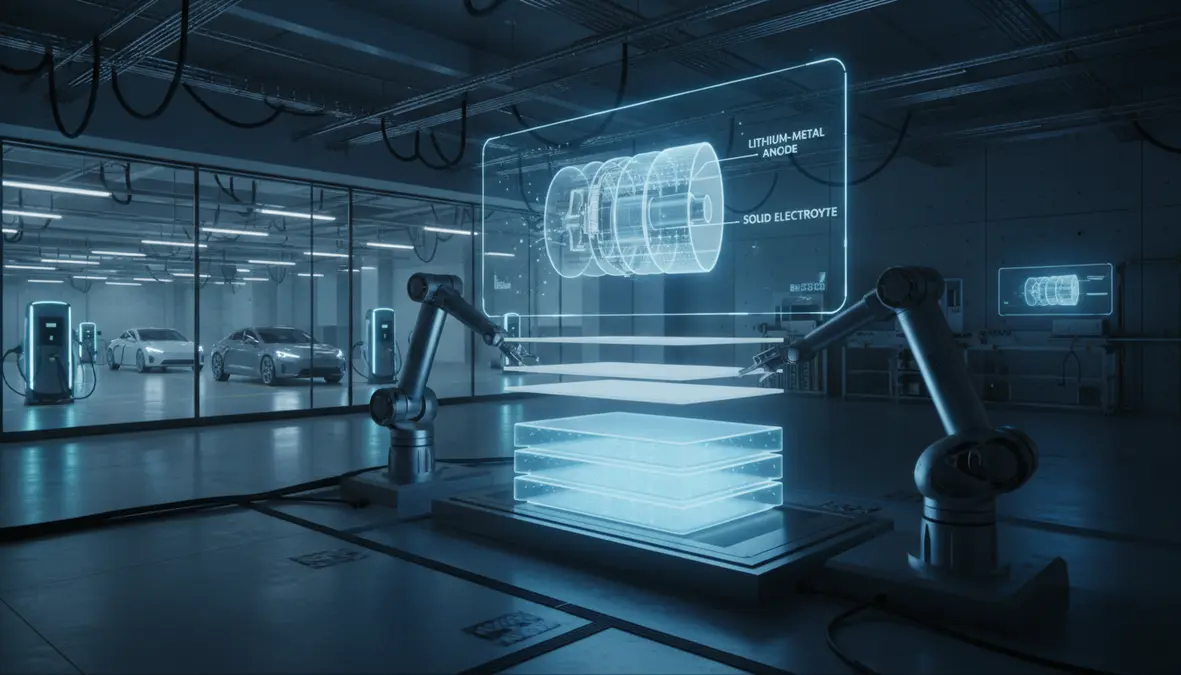
A solid-state battery replaces that liquid electrolyte with a solid material — typically a ceramic oxide, a sulfide glass, or a polymer composite. This single substitution unlocks a cascade of improvements. Solid electrolytes are non-flammable, eliminating the thermal runaway risk that has caused EV recalls and airplane groundings. They enable the use of a lithium-metal anode — the holy grail of battery chemistry — which stores far more energy per gram than the graphite anodes in conventional cells. And they operate across wider temperature ranges, simplifying thermal management and reducing pack-level overhead.
2x Energy Density
Solid-state cells achieve 800–1,000 Wh/L compared to 400–500 Wh/L for conventional lithium-ion, enabling EVs with 600+ mile range or smartphones that last three full days on a single charge.
10-Minute Fast Charging
Solid electrolytes support higher current densities without dendrite formation, enabling ultra-fast charging that rivals the convenience of filling a gas tank — the single biggest barrier to mass EV adoption.
Inherent Safety
No flammable liquid means no thermal runaway, no battery fires, and no need for heavy cooling systems — reducing pack weight by up to 30% and eliminating the leading safety concern in electrification.
The Solid-State Landscape in 2026
The solid-state battery industry has matured from laboratory curiosity to industrial-scale development. Over $12 billion in cumulative investment has flowed into solid-state startups and corporate R&D programs since 2020, and 2026 marks the year that multiple companies transition from prototype cells to pilot production lines. The competitive landscape spans automotive giants, dedicated startups, and battery manufacturing conglomerates — each pursuing different electrolyte chemistries and manufacturing approaches.
| Company | Electrolyte Type | Key Milestone (2025–2026) | Production Target |
|---|---|---|---|
| Toyota | Sulfide-based ceramic | 900 Wh/L production cell demonstrated, pilot line operational | Vehicle launch Q4 2027, mass production 2028 |
| Samsung SDI | Sulfide (Argyrodite) | Prototype cells shipped to BMW and Hyundai for vehicle testing | Pilot production 2027, full scale 2029 |
| QuantumScape | Lithium-garnet ceramic oxide | 24-layer cells pass Volkswagen validation, QS-0 line producing A-samples | B-sample production 2026, C-samples 2027 |
| Solid Power | Sulfide-based | A-2 sample cells delivered to BMW, production-compatible roll-to-roll process validated | Pilot line 2026, vehicle integration 2028 |
| CATL | Condensed matter (semi-solid) | Condensed battery enters aviation certification for eVTOL aircraft | EV deployment 2027 |
| ProLogium | Ceramic oxide | Dunkirk gigafactory under construction, Mercedes-Benz partnership active | 2 GWh initial capacity by 2027 |
The Three Electrolyte Families
Not all solid-state batteries are created equal. The choice of solid electrolyte material defines the battery's performance characteristics, manufacturing complexity, and cost trajectory. Three families dominate the competitive landscape in 2026:
Oxide Ceramics
Oxide-based solid electrolytes — including lithium lanthanum zirconium oxide (LLZO, also called lithium garnet) and NASICON-type materials — offer excellent chemical stability and wide electrochemical windows. QuantumScape's proprietary lithium-garnet separator is the most prominent example: an ultra-thin ceramic membrane that conducts lithium ions while physically blocking dendrite growth. The challenge with oxides is brittleness — they crack under mechanical stress — and the high sintering temperatures required during manufacturing, which increase energy costs and limit throughput.
Sulfide Glasses
Sulfide-based electrolytes, such as argyrodite (Li₆PS₅Cl) and lithium phosphorus sulfide (Li₃PS₄), offer the highest ionic conductivity of any solid electrolyte — matching or exceeding liquid electrolytes at room temperature. This makes them the preferred choice for high-power applications like EVs. Toyota and Samsung SDI have both bet heavily on sulfide chemistries. The tradeoff is moisture sensitivity: sulfide electrolytes react with water to produce toxic hydrogen sulfide gas, requiring stringent dry-room manufacturing environments that add cost and complexity.
Polymer Composites
Polymer and hybrid polymer-ceramic electrolytes represent the most manufacturing-friendly approach. Companies like Blue Solutions (Bolloré Group) have been producing polymer solid-state batteries for over a decade, primarily for fleet vehicles. While early polymer electrolytes suffered from low ionic conductivity at room temperature, next-generation composite materials — embedding ceramic nanoparticles in polymer matrices — are closing the performance gap while maintaining the processability and flexibility advantages that make polymer cells compatible with existing roll-to-roll manufacturing equipment.
The Manufacturing Challenge
Building a solid-state battery that works in the lab is one thing. Building billions of them at competitive cost is another — and manufacturing is where the industry's hardest battles are being fought in 2026. Conventional lithium-ion cell production is a mature, highly optimized process built around liquid electrolyte filling. Solid-state cells require fundamentally different manufacturing steps: depositing ultra-thin ceramic or sulfide layers with nanometer-scale uniformity, achieving intimate contact between rigid solid surfaces without the wetting advantage of liquids, and maintaining material purity in controlled atmospheres.
"The chemistry works. We proved that three years ago. Now the question is: can you make a billion cells a year at $80 per kilowatt-hour? That's a manufacturing problem, not a materials science problem — and it's exactly the kind of problem that industrial engineering solves when the economics justify the investment."
Several key manufacturing breakthroughs in 2025–2026 have de-risked the path to scale. Toyota developed a dry electrode coating process that eliminates the need for toxic NMP solvents and reduces cell manufacturing energy consumption by 40%. Solid Power validated a sulfide electrolyte roll-to-roll deposition process using modified conventional equipment — proving that solid-state cells can be manufactured on existing lithium-ion production lines with targeted retrofits rather than greenfield factories. Samsung SDI's all-solid-state pilot line in Suwon achieved a first-pass yield above 85%, a critical threshold for economic viability.
Beyond Electric Vehicles: Where Solid-State Batteries Will Transform Industries
While EVs dominate the headlines, solid-state batteries are poised to transform far more than transportation:
- Consumer Electronics: Samsung and Apple are both developing solid-state cells for smartphones and wearables. Higher energy density means thinner devices with multi-day battery life, while the absence of flammable electrolyte enables new form factors including truly flexible and rollable displays.
- Aviation and eVTOL: Electric vertical takeoff and landing aircraft require batteries with extreme energy density and absolute safety. CATL's condensed battery — a semi-solid-state design — is entering aviation certification for use in Lilium and Joby air taxis, with energy densities exceeding 500 Wh/kg.
- Grid-Scale Storage: Solid-state batteries' long cycle life (3,000+ cycles vs. 1,000–2,000 for conventional lithium-ion) and wide operating temperature range make them compelling for stationary energy storage, where they can pair with solar and wind installations to provide dispatchable renewable power.
- Medical Devices: Non-flammable, high-density solid-state cells enable smaller, longer-lasting implantable medical devices — from next-generation pacemakers to neural stimulators — with improved safety profiles for in-body applications.
- Space and Defense: NASA and the U.S. Department of Defense are funding solid-state battery programs for satellites, drones, and soldier-portable power systems that must operate in extreme temperature and vibration environments.
The Road Ahead: 2026–2030
The solid-state battery industry is entering its most critical phase. Toyota's 2027 vehicle launch will be the first true consumer test of the technology at scale. QuantumScape's partnership with Volkswagen's PowerCo division is expected to produce the first solid-state cells for VW's electric platform by 2028. Samsung SDI is investing $3.2 billion in a dedicated solid-state gigafactory in South Korea, targeting 20 GWh annual capacity by 2029.
Cost remains the key variable. Today's solid-state prototype cells cost an estimated $250–400 per kWh — two to four times the cost of conventional lithium-ion at $100–130/kWh. But the industry's cost reduction roadmap mirrors the trajectory that lithium-ion itself followed: aggressive learning curves driven by manufacturing scale, yield improvements, and material cost reductions as supply chains mature. Multiple analysts project solid-state cells reaching cost parity with lithium-ion by 2030–2032.
The implications are enormous. A world with solid-state batteries is a world where EVs cost less than gas cars and charge in ten minutes, where commercial aircraft fly on electricity, where grid storage makes renewable energy fully dispatchable, and where the fire risk that has haunted lithium-ion for two decades is finally eliminated. The liquid electrolyte era served us well — but 2026 is the year the solid-state future becomes inevitable.