TinyML in 2026: How Neural Networks Run on a Two Dollar Microcontroller, Why Milliwatts Beat the Cloud, and Where On Device Intelligence Actually Pays Off
- Internet Pros Team
- September 3, 2026
- AI & Technology
While the industry argues about trillion parameter models and gigawatt data centres, a quieter version of machine learning has been spreading into places with no network, no cooling and no battery to spare. It runs on a chip that costs less than a cup of coffee, draws less power than an LED, and never sends a byte anywhere. TinyML is not a scaled down imitation of cloud AI. It is a different engineering problem with a different economic argument, and in 2026 it is in far more products than most people realise.
The Round Trip Was Always the Weak Link
The default architecture for a connected sensor has been the same for a decade: capture data, upload it, run the model in the cloud, send an answer back. For anything needing a large model that remains the right answer. But the round trip carries four costs that get harder to swallow the more devices you deploy.
Latency is the obvious one. A hundred milliseconds is invisible in a chat interface and unacceptable in a machine that has to stop a cutting head before it damages a part. Bandwidth is the second: streaming raw vibration or audio from a few thousand sensors is a serious data bill for information that is almost entirely uninteresting. Power is the third, and it is decisive, because the radio is by a wide margin the hungriest component on most embedded boards. Transmitting a kilobyte can cost more energy than a million arithmetic operations.
Privacy is the fourth, and it is now a design requirement rather than a talking point. A microphone that recognises a wake word locally and never records anything else is a far easier product to sell, certify and defend than one that streams audio to a server and promises to behave.
The core insight of TinyML is not that small models are as good as large ones. It is that most sensor data is boring, and deciding whether something is boring is a cheap enough job to do on the device itself.
What Actually Fits in 256 Kilobytes
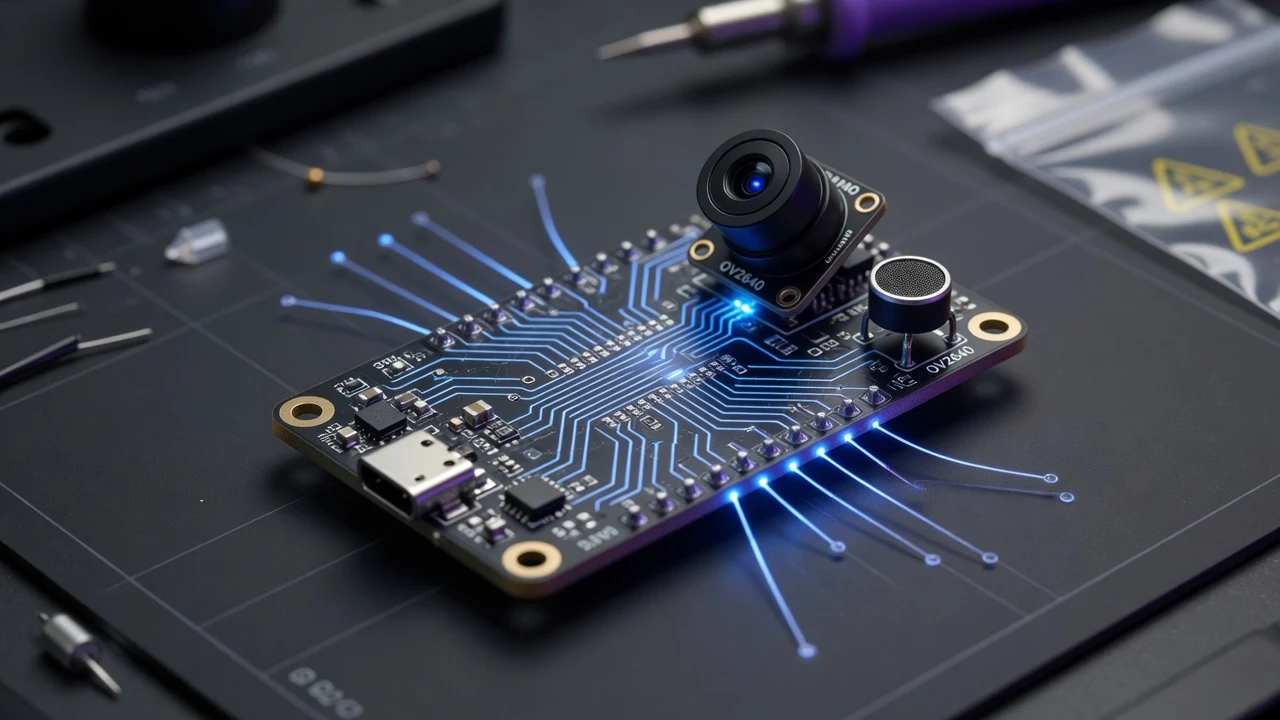
The constraint that defines the field is memory. A typical target has a few hundred kilobytes of RAM and perhaps a megabyte or two of flash, runs at tens or low hundreds of megahertz, and has no operating system worth the name and no floating point unit to speak of. Everything, including the model weights, the input buffer and the intermediate activations, has to live inside that budget.
Within it, a surprising amount is possible: keyword spotting, gesture and activity recognition from an accelerometer, anomaly detection on vibration or current draw, person detection at low resolution, and a growing range of small vision tasks. What does not fit is anything resembling a language model. Practitioners who try to shrink a general model into an embedded target usually fail; the ones who succeed pick a narrow question and train something that answers only that question.
| Tier | Typical hardware | Power draw | What it is good for |
|---|---|---|---|
| Cloud | GPU or accelerator clusters | Kilowatts per node | Training, large models, anything needing broad context |
| Edge gateway | Single board computer or industrial PC | Five to fifty watts | Video analytics, aggregation, running several models at once |
| TinyML endpoint | Cortex-M class or RISC-V microcontroller, sometimes with a small NPU | Microwatts to tens of milliwatts | Always on detection, filtering, waking the rest of the system |
These tiers are complementary, not competing. The best designs use the microcontroller as a gatekeeper: it listens or watches continuously at almost no energy cost, and only when it sees something worth a second opinion does it wake the radio, the application processor or the cloud. The saving is not a percentage; it is often two orders of magnitude.
How a Model Gets Small Enough
Four techniques do most of the work, and they are usually applied together rather than chosen between.
Quantization
Weights and activations are converted from 32 bit floating point to 8 bit integers, and increasingly to four bits or fewer. This cuts memory roughly by a factor of four and, more importantly, lets the chip use integer arithmetic it can execute quickly. Done properly, with calibration performed during training rather than bolted on afterwards, the accuracy loss is often under one percent.
Pruning and sparsity
Most trained networks carry a large number of weights that contribute almost nothing. Removing them in a structured pattern, so the remaining computation still maps cleanly onto the hardware, shrinks the model without the ragged memory access that makes unstructured sparsity slower in practice than in theory.
Distillation
A large teacher model is trained first, then used to supervise a much smaller student. The student learns from the teacher outputs rather than the raw labels alone, and reliably ends up better than the same architecture trained from scratch.
Hardware aware architecture search
Rather than designing a network and hoping it fits, the search optimises for latency and memory on the specific target chip alongside accuracy. This is where the biggest recent gains have come from, because a theoretically smaller model is worthless if its operator mix runs badly on the silicon in front of you.
What People Are Actually Shipping
TinyML in the Field
- Predictive maintenance. A vibration or current sensor learns the normal signature of a motor or bearing and reports only deviations, replacing both scheduled downtime and continuous streaming.
- Always on voice. Wake word detection on a milliwatt budget is the reason a battery device can listen for months without a charger and without recording anything.
- Agriculture and environment. Solar or battery nodes classifying pest sounds, livestock behaviour or water flow where there is no reliable connectivity at all.
- Retail and building sensing. Low resolution occupancy and people counting where a camera stream is both a bandwidth and a privacy problem.
- Medical wearables. Arrhythmia and fall detection running locally so the device still functions when the phone is out of range.
- Logistics. Shock, tilt and temperature classification inside a shipping label, on a printed battery.
Where It Disappoints
The honest failure modes are worth stating. Data collection is the real project: nobody has a public dataset of your pump, in your factory, on your mounting bracket, so the model is only as good as the months of labelled recordings you were willing to gather. Teams routinely underestimate this by a factor of five.
Deployment tooling is still rough compared with the server world. Getting a trained model through conversion, quantization and onto the device involves a chain of tools that each have opinions, and a single operator your runtime does not support will end a week.
And there is drift. A model trained on last year machines quietly degrades, and unlike a cloud service you cannot watch it closely, because the whole point is that the device does not send you its data. The mature answer is to send small summaries and confidence statistics rather than raw signals, and to plan for retraining from the start.
The Honest Assessment
TinyML is not the future of artificial intelligence, and the people who work in it do not claim it is. It is the part of the field where the constraints are hardest and the payback is easiest to calculate. If a device has to run for a year on a coin cell, respond in ten milliseconds, work in a basement with no signal, or convince a customer that nothing left the building, there is currently no other answer.
For businesses evaluating it, the question is not whether the model is impressive. It is whether the decision you need made is narrow enough to define, whether you can gather the data to teach it, and whether moving it onto the device removes a cost you already pay in bandwidth, batteries, latency or liability. When all three answers are yes, the economics are not close.