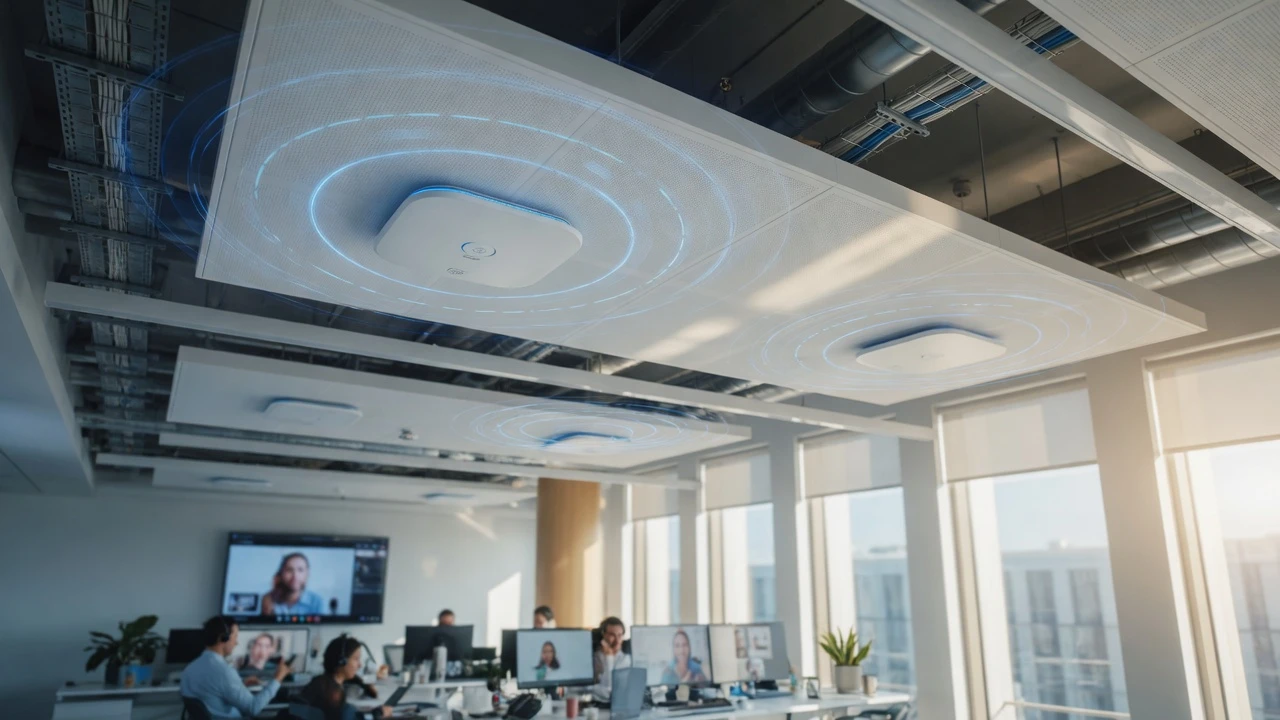
Wi-Fi 8 Is Not a Speed Upgrade: What 802.11bn Ultra High Reliability Actually Fixes, and Why That Matters More Than Another Gigabit
- Internet Pros Team
- September 6, 2026
- Networking & Security
Every Wi-Fi generation for the last twenty years has been sold on the same promise: a bigger number. Faster, then faster again, each one arriving with a headline throughput figure that nobody has ever measured in an actual office. Wi-Fi 8 breaks the pattern. The peak speed of 802.11bn is, by design, roughly the same as Wi-Fi 7. The engineers building it decided that the speed race was finished and that the real problem was somewhere else entirely.
The Number on the Box Stopped Describing the Experience
Ask anyone in a busy office what is wrong with the wireless and nobody says it is too slow. They say it drops during calls. They say the far conference room is unusable. They say it works in the morning and falls apart when the floor fills up. They say their laptop clings to the access point by the kitchen long after they have walked away from it.
None of those complaints are about bandwidth. They are about consistency: the difference between the best case and the worst case. A network that delivers two gigabits at the desk nearest the access point and four megabits with intermittent loss at the edge of coverage is not a fast network. It is a fast network in one spot and an unreliable one everywhere people actually sit.
Wi-Fi 7 already pushed the theoretical ceiling past twenty gigabits per second, a figure so far beyond what any single device needs that raising it again would be a marketing exercise rather than an engineering one. So the 802.11bn task group did something unusual for this industry. It kept the ceiling and went after the floor.
Nobody has ever left a meeting complaining that the Wi-Fi peaked at only nine gigabits. They complain that they froze for four seconds while somebody was asking them a question.
What Ultra High Reliability Actually Means
The formal name of the 802.11bn project is Ultra High Reliability, and the targets are stated in a way no previous amendment bothered with. Instead of a peak rate, the goals are expressed in percentiles: lift the throughput of the worst-served users, cut the worst-case latency, and reduce the packet loss that forces retransmission. The measure of success is what happens to the unluckiest device on the network, not the luckiest one.
This is a meaningful shift in philosophy. Optimising an average is easy and mostly pointless, because a user experiences the tail, not the mean. A video call does not average its way through a two hundred millisecond stall; it stutters, and everybody notices. Real-time applications, from voice and video to industrial sensors and headsets, care far more about predictable delivery than about maximum throughput.
It is also a tacit admission about how Wi-Fi actually gets deployed. In any real building there are multiple access points, and they interfere with one another. Wi-Fi has always treated each access point as an independent island competing for airtime with its neighbours. Wi-Fi 8 is largely about making those islands cooperate.
Four Generations, and What Each One Was Really About
| Generation | Standard | Headline change | The actual problem it solved |
|---|---|---|---|
| Wi-Fi 6 / 6E | 802.11ax | OFDMA, plus the 6 GHz band | Efficiency in dense environments, and a large stretch of clean spectrum with no legacy devices in it |
| Wi-Fi 7 | 802.11be | 320 MHz channels, 4096-QAM, Multi-Link Operation | Extremely high throughput, and the ability for one device to use two bands at once |
| Wi-Fi 8 | 802.11bn | Multi-AP coordination and seamless roaming | Consistency: worst-case latency, edge-of-coverage throughput and handoffs between access points |
Notice that the third row does not contain a speed figure. Wi-Fi 8 reuses the same spectrum, the same channel widths and the same modulation as Wi-Fi 7. There is no new band. What changes is coordination.
Multi-AP Coordination Is the Headline Nobody Will Print
The most substantial work in 802.11bn is a family of techniques that let neighbouring access points behave as one system rather than as competitors. Three matter most.
Coordinated spatial reuse allows two access points to transmit at the same time on the same channel, each turning its power down to a level that still reaches its own client without drowning the other. Today, one of them simply waits. Turning that dead airtime into useful transmission is where a large share of the promised gains come from.
Coordinated beamforming goes further: access points shape their transmissions so the energy aimed at one client is deliberately nulled in the direction of a neighbour receiving something else. It is two people speaking at once, each aiming away from the other conversation.
Seamless roaming is the one users will feel. A modern laptop decides on its own when to switch access points, and it does so badly, hanging on to a weak signal until the connection is nearly unusable and then dropping the session while it reconnects. Wi-Fi 8 moves that decision into the infrastructure and aims to make the handoff invisible, without the gap that currently kills a call mid-sentence.
The Timeline, Honestly Stated
Where 802.11bn Stands
- Now: the specification is still in draft. Features are being added, argued over and removed.
- Ratification: the IEEE process points at roughly 2028 for a final standard, and standards timelines slip more often than they accelerate.
- Certified products: realistically 2028 to 2029 for the Wi-Fi Alliance certification programme that makes interoperability a safe assumption.
- Client devices: later still. A network feature only helps when the phones and laptops support it, and fleet refresh cycles run three to five years.
Anyone selling a Wi-Fi 8 access point before ratification is selling a draft implementation, exactly as happened with Wi-Fi 6 and Wi-Fi 7. Early hardware usually works, usually needs firmware updates to reach certification, and some pre-standard features quietly never arrive.
What To Do Now, Given That It Is Years Away
The useful conclusion is not to wait. It is that most of what Wi-Fi 8 promises can be partially bought today with design rather than silicon, and every one of these steps also makes the eventual upgrade work better.
- Fix roaming before buying radios. Enable the fast-transition and roaming-assistance standards your controller already supports. Most enterprise gear has had them for years with the features switched off.
- Measure the edge, not the desk. A site survey that reports coverage at the access point tells you nothing. What matters is throughput and latency at the worst seat in the building during the busiest hour.
- Add access points before adding gigabits. Coverage density fixes more real complaints than a faster radio, because the problem is almost always distance and interference rather than capacity.
- Use 6 GHz properly. If your devices support it, the 6 GHz band is the closest thing to the Wi-Fi 8 experience available today, simply because so little else is transmitting in it.
- Check the wired side. An access point capable of multigigabit throughput connected to a gigabit switch port over ageing cabling is a gigabit access point, whatever the label says.
Where Wi-Fi 8 Will Disappoint
Multi-AP coordination requires access points that can actually coordinate, which in practice means a single vendor and a single controller across the whole deployment. A building with equipment from three suppliers accumulated over eight years will get very little of this. That is a commercial constraint dressed as a technical one, and it is worth understanding before the refresh budget is written.
It also does nothing about the causes of most wireless complaints that are not wireless at all: an overloaded firewall, a saturated upload, a misconfigured VPN, or a video platform having a bad afternoon. Replacing access points to fix those is an expensive way to learn where the problem was.
Still, the direction is the right one. After two decades of chasing a number that stopped describing anything users experience, an amendment aimed squarely at the worst case is overdue. The next generation of Wi-Fi will not feel faster. If it works, it will feel like it stopped failing, which is what people were asking for all along.